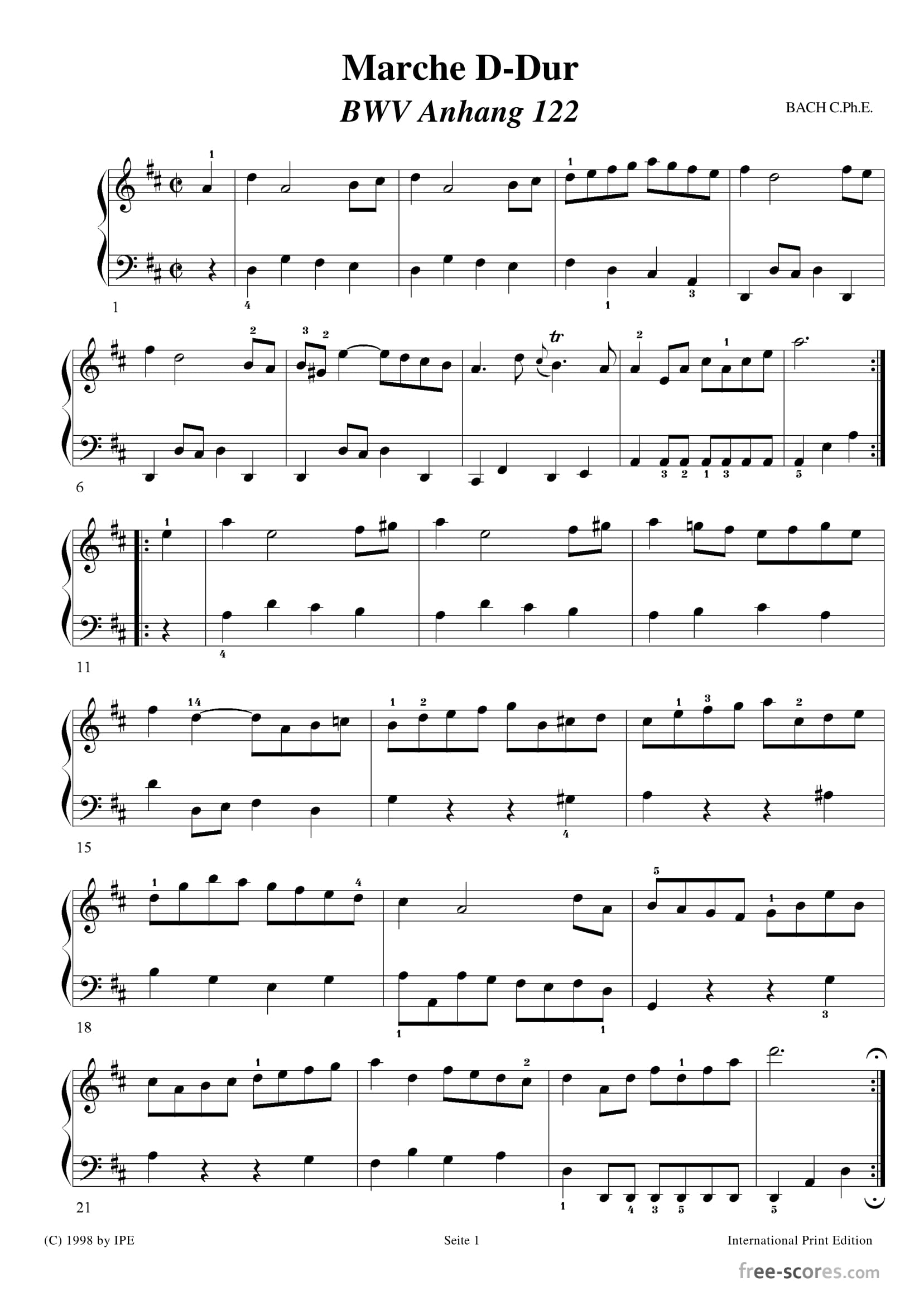
This march is included in the Notebook for Anna Magdalena Bach (1725). The composer, Carl Philipp Emanuel Bach (1714-1788), was the second son of Johann Sebastian Bach and his first wife Maria Barbara. Among J.S. Bach's many sons, Emanuel became the most distinguished musician. During his lifetime, he was known as "the Great Bach," with a reputation that even surpassed his father's. When Mozart famously said, "Bach is the father; we are the children," he was actually referring to Emanuel, not Sebastian.
Written in cut time (2/2) in D major, the piece has a bright, celebratory character. It follows a binary form, modulating to A major in the middle section, with the climax arriving at the dominant seventh chord in the final phrase.
The key to performance lies in shaping the phrases carefully. Upbeat notes should lead naturally into the downbeats, with dynamics reflecting the rise and fall of each phrase. Detaching quarter notes and longer values creates the crisp articulation characteristic of a march.
(Source)